What a Perfume Brief Needs Before Sampling Starts
A brief is not a description of a smell you like; it is the set of constraints the development team has to design inside. Market, wear profile, price ceiling, volume, packaging and the two or three things that must not change are all part of it. Brands that write those decisions down before sampling usually reach an approved formula in fewer rounds, and the rounds they save are the expensive ones.
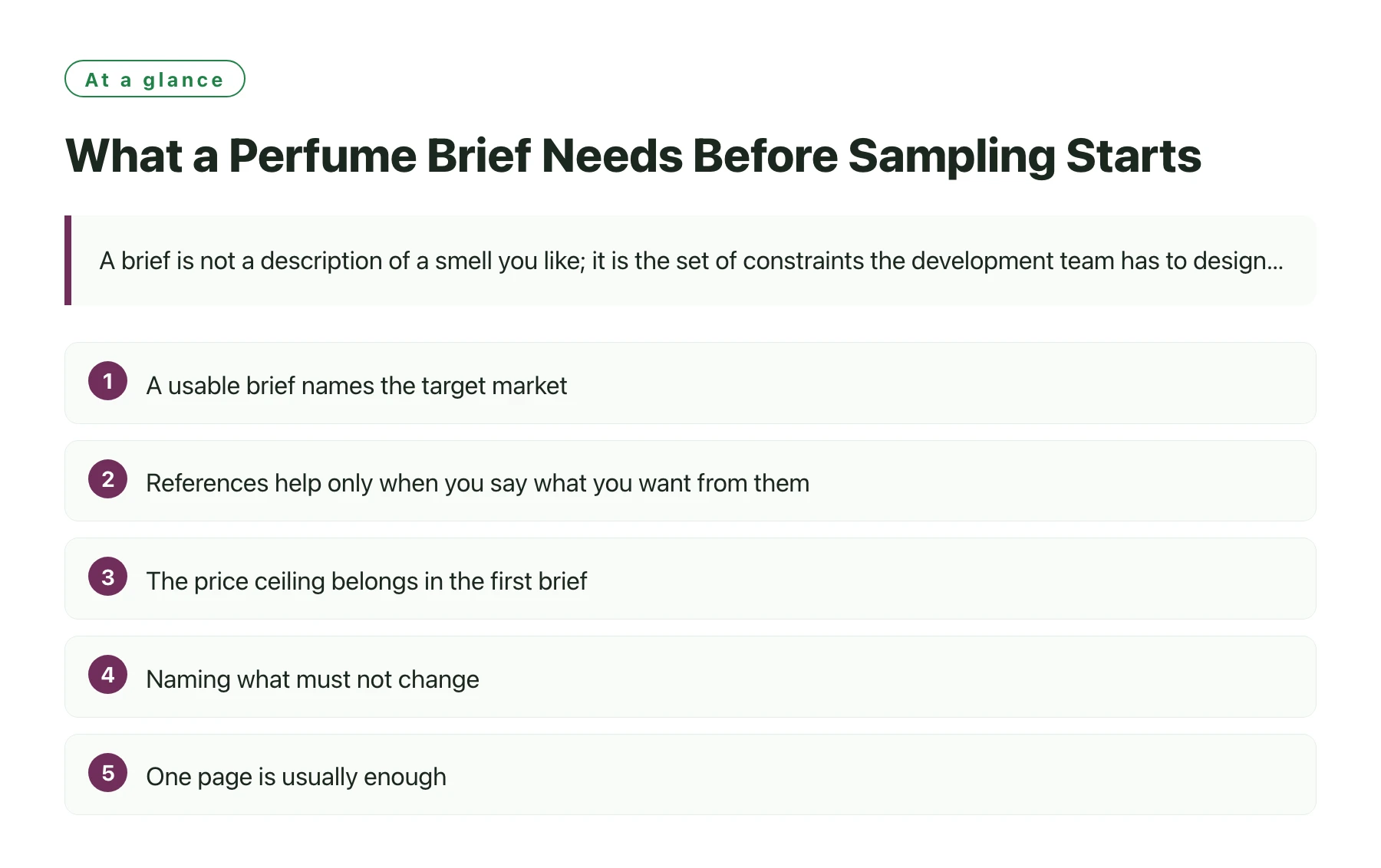
Key takeawaysA usable brief names the target market, the wear profile, the price ceiling and the expected volume before any sample is made. · References help only when you say what you want from them, because liking a scent and wanting to copy it are different instructions. · The price ceiling belongs in the first brief, since it constrains which aroma materials the development team can even consider. · Naming what must not change, such as a note you have already advertised, prevents a beautiful sample you cannot use. · One page is usually enough; length does not compensate for missing decisions.
The first sample a brand receives is often judged as a verdict on the manufacturer. Usually it is a verdict on the brief. When the direction is loosely described, the development team fills the gaps with their own taste, and the sample that comes back is a proposal about them rather than about your product.
The cost of that is not just money. A sampling round takes time to produce, time to evaluate and time to discuss, and each one pushes the launch date. Two avoidable rounds can be the difference between reaching a seasonal window and missing it.
This guide lists the decisions to make before the brief is sent, shows how to phrase them so they constrain without micro-managing, and flags the fields most brands forget.
The decisions a brief has to contain
There are seven things a fragrance developer needs from a brand: where the product will be sold, who will wear it, when it should be noticeable, how long it should last, what it may cost, how much will be ordered, and which existing elements are fixed. Each one removes a degree of freedom, and removing freedom is what makes a brief useful.
Omitting any of them does not remove the constraint from the project, it just moves the decision to somebody who knows your product less well. That is the mechanism behind most disappointing first samples.
Market, climate and wear profile
The same formula reads differently in a humid market than in a dry one, and differently on a shelf in a warm climate than in a cold one. Naming the market is not paperwork; it changes which materials the perfumer will lean on.
The wear profile is the second half of this. Write down when the product should be noticed, how far it should carry, and how long it should still be detectable. Those three sentences do more work than any adjective about mood.
Price ceiling and volume
The fragrance compound is typically the most expensive input in the bottle, so the unit cost ceiling directly limits which materials are possible. A perfumer who knows the ceiling can propose something buildable, and one who does not will propose something that has to be redesigned.
Volume matters for the same reason. Small initial runs and larger repeat orders can justify different base choices and different packaging, and suppliers price accordingly.
What must not change
If you have already advertised a note, named a hero ingredient, or committed to a scent family, say so. A sample built around a beautiful material you cannot use is wasted work for both sides.
This is also where restrictions belong. Materials in common use carry usage limits set by the industry's published standards, and those limits depend on the product category, so the brief should state the category clearly [1]. A developer who knows the category can stay inside the limits from the first version instead of rebuilding later.
Building the brief, one decision at a time
- Write the product sentence firstOne sentence describing what the product is, who buys it and what it promises, before any note is mentioned.
- Add the three performance targetsWhen it should be noticed, how far it should carry, and how long it should remain detectable on skin.
- Set the unit cost ceilingGive the maximum cost of the finished unit at your target volume, and say whether the ceiling includes packaging.
- Choose references and explain themTwo or three products with a sentence each on what you want from them, such as the opening of one and the dry-down of another.
- List the fixed elementsNotes you have advertised, a scent family you have committed to, a colour, or a claim on the pack that the scent has to support.
- State the market and any restrictions you already knowName the countries, the product category and any ingredient rules you are aware of, so compliance is designed in rather than checked afterwards.
- Ask what the sampling round includesConfirm how many modifications are covered, how long each round takes, and what information comes back with the sample.
The field brands forget most often is the cost of the box, not the cost of the juice. If the brief gives a unit ceiling and says nothing about whether packaging sits inside it, the developer will optimise the fragrance against the whole number and the project will overrun on cartons and bottles. Say explicitly what the ceiling covers, and separate the fragrance budget from the packaging budget so each can be managed on its own. Developers such as Xuelei Cosmetics will normally ask for that split, but a brief that already contains it saves a round.
Brief field guide: what to write and what it prevents
| Brief field | Weak version | Strong version | What it prevents |
|---|---|---|---|
| Market | Global launch | Sold in the United Kingdom and Germany, in a warm indoor retail environment | A formula tuned for a climate you are not selling in |
| Wear profile | Should last a long time | Detectable at arm's length for four hours, perceptible on skin at hour eight | A scent judged weak at the two-hour mark |
| Cost ceiling | Keep it affordable | Fragrance compound budget of a fixed amount per unit at an annual volume of one hundred thousand units | A formula that has to be redesigned for cost |
| References | Something like this one | The opening brightness of one reference and the woody dry-down of another | A sample that copies the whole reference instead of the part you wanted |
| Fixed elements | Nothing is fixed yet | The pack carries a claim about a named hero note | A sample built around a material you cannot advertise |
Use the strong column as the standard. You do not have to fill every field perfectly on the first attempt, but every field you leave in the weak column is a decision you have handed to somebody else.
Before the brief leaves your desk
A brief that reads clearly to you can still be ambiguous to a developer who does not know your brand. Two checks catch most of that gap, and both take minutes.
The first is reading the brief aloud to somebody outside the project and asking them to describe the product back to you. The second is checking the words you used for references, because perfumery vocabulary is precise in ways everyday language is not. Basic references on note families and how they are described are widely available and worth a look before you write [2].
Separate wishes from requirements
Mark clearly which lines are non-negotiable and which are preferences. Developers can trade preferences against each other, but they cannot trade something you presented as a requirement.
A short brief with that distinction is more useful than a long one where everything reads equally important.
Say how you will evaluate the sample
Tell the developer that you will assess the sample on skin at two and six hours, in the intended package, on more than one person. Knowing the evaluation method changes how the sample is built and documented.
It also sets an expectation that the sample is a working proposal rather than a finished product, which makes technical feedback easier for both sides.
Keep the brief and every revision
Version the brief. When the direction shifts mid-project, note the change and the date, so the approved formula can be traced back to the instruction that produced it.
That record is also what protects you if the team changes. For a worked example of how briefing and development fit together at a fragrance manufacturer, the process detail is often published alongside the service description.
Sources
- IFRA: Safe Use and Fragrance Science —— IFRA's explanation of how fragrance materials are scientifically assessed for safe use and how those conclusions are applied by the industry.
- The Good Scents Company —— A reference database of aroma materials with odour descriptions, CAS numbers and typical usage information.
Frequently asked questions
How long should a perfume brief be?
One to two pages is usually enough. What matters is that the decisions are present and unambiguous, not that the document is long. A single page covering market, wear profile, cost ceiling, volume, references and fixed elements outperforms a long document that leaves those blank.
Should I name specific perfume references in the brief?
Yes, if you explain what you want from each one. Saying you like a fragrance without saying which part means the developer may reproduce the whole thing. Pointing to the opening of one and the dry-down of another communicates the direction much more precisely.
What if I do not know my target unit cost yet?
Give a range and say it is provisional. A range still lets the developer choose materials sensibly and tells them which end of the market you are aiming at. Waiting for a precise figure usually costs more time than starting with an approximate one.
How many sampling rounds should I budget for?
Two to three modification rounds is a realistic planning assumption for a new direction, with the first round treated as a proposal rather than a near-final product. A tight, complete brief often brings approval inside that range.
Do I need to specify the product category in the brief?
Yes, because usage limits for fragrance materials are set according to the product type and how it is applied. Naming the category lets the developer build inside those limits from the start and avoids a reformulation after the formula is otherwise approved.