Why Choose Medium Density Fibreboard for Retail Displays?
Medium Density Fibreboard works well for retail displays because it combines a smooth face, uniform machining, repeatable sheet dimensions, and compatibility with paint, laminate, veneer, hardware, and CNC production. The Composite Panel Association lists MDF densities at roughly 561–961 kg/m³, giving fixture engineers a broad range for different panel grades. A standard 1220 × 2440 × 18 mm sheet at 700 kg/m³ weighs about 37.5 kg, so weight, shelf span, fastener position, and transport method can be calculated before production. For U.S. projects, EPA TSCA Title VI limits formaldehyde emissions from standard MDF to 0.11 ppm, making board certification part of material specification.
Retail fixtures are usually produced as repeatable components rather than one-off furniture. Side panels, shelves, bases, headers, plinths, doors, graphic carriers, and lighting channels may all come from the same sheet format. MDF has no natural knots and no grain direction, so CNC routing behaves more consistently across the panel than it does with many solid-wood parts. When a retailer needs 50, 500, or several thousand units, repeatability reduces the amount of manual adjustment between components.
The material also gives designers a predictable starting surface. Paint, melamine, decorative paper, high-pressure laminate, wood veneer, PVC film, and printed graphics can all be applied over suitable MDF grades and correctly prepared surfaces. Paint quality depends heavily on edge preparation because a machined MDF edge absorbs more coating than the factory face. Two similar panels can therefore look different after finishing if one edge receives only one primer coat while another is sealed, sanded, primed, and sanded again.
For a painted display, the face is rarely the difficult area. Routed edges, exposed cut-outs, logo recesses, and corners usually need more preparation because cutting exposes the fibre structure inside the board.
Thickness selection should follow fixture geometry rather than habit. Common retail fabrication uses panels around 9, 12, 15, 18, and 25 mm, although suppliers offer other sizes. EN 622-5:2010, for example, gives different mechanical requirements according to thickness. For general-purpose MDF in dry conditions, the standard lists bending strength requirements of 20 N/mm² for boards above 12 mm and up to 19 mm, and 18 N/mm² for boards above 19 mm and up to 30 mm. The same thickness groups have 24-hour thickness-swelling limits of 12% and 10%, respectively.
Those numbers explain why an 18 mm shelf cannot be evaluated only by saying “MDF is strong.” Shelf depth, unsupported span, product weight, fixing method, repeated loading, and edge profile all change performance. A 600 mm cosmetics shelf carrying a few kilograms works under very different conditions from a 1,200 mm shelf holding bottled products. Longer spans may need thicker panels, additional brackets, a metal rail, or another panel material rather than simply adding more screws.
Fastener design deserves the same attention. The USDA Wood Handbook has published MDF property requirements that include both face and edge screw-holding values, showing that screw performance is not identical in the two directions. Older benchmark requirements for medium-density interior MDF included face screw-holding values above 1,300 N for some thickness classes, while edge values were lower. Actual procurement should use the current technical sheet for the selected board, because density, resin system, thickness, and manufacturer affect fastening performance.
Pilot holes, sufficient edge distance, suitable screw geometry, confirmat-type fittings, inserts, cams, dowels, and mechanical connectors can improve repeat assembly. Putting a screw too close to a routed edge can damage the fibre around the fixing point, especially when the component is assembled and disassembled several times. Retail programs expected to move between stores should therefore be designed differently from permanent fixtures installed once.
Material weight becomes important when displays are packed, shipped, carried through a store, and installed overnight. The Composite Panel Association gives an MDF density range of approximately 35–60 lb/ft³, equivalent to about 561–961 kg/m³. At 700 kg/m³, a 1220 × 2440 × 18 mm panel is about 37.5 kg before laminate, hardware, lighting, glass, steel, or packaging is added. At 800 kg/m³, the same sheet is about 42.9 kg, roughly 14% heavier.
| Design item | Practical reference |
|---|---|
| Typical sheet example | 1220 × 2440 mm |
| Example panel thickness | 18 mm |
| MDF density range reported by CPA | 561–961 kg/m³ |
| 18 mm sheet at 700 kg/m³ | ~37.5 kg |
| 18 mm sheet at 800 kg/m³ | ~42.9 kg |
| U.S. TSCA Title VI MDF limit | 0.11 ppm |
| U.S. thin MDF limit | 0.13 ppm |
| Thin MDF definition under EPA rule | ≤8 mm |
Weight is one reason good retail fixtures often mix materials. MDF can form painted sides, bases, headers, back panels, and branded surfaces, while steel handles narrow high-load members, acrylic holds products, glass provides transparent shelving, and aluminum profiles support LED lighting. A hybrid fixture can therefore keep the machining and finishing benefits of MDF without asking it to perform every structural task.
CNC production adds another manufacturing advantage. A digital nesting program can place several shelves, dividers, side panels, and graphic supports on one sheet, while common drilling patterns can be repeated without marking every component manually. Cutting efficiency depends on component geometry, tool diameter, holding method, grain direction of decorative overlays, and required edge quality. Even a 5% improvement in sheet utilization becomes noticeable when a rollout consumes 1,000 sheets.
Tooling also affects the result. Feed rate, spindle speed, cutter diameter, number of flutes, depth per pass, and tool condition influence edge quality and machining temperature. A fresh compression or carbide router bit can produce cleaner profiles than a worn cutter, reducing later sanding. For painted routed logos and curved edges, production teams should approve a physical sample before a large run rather than relying only on a CAD rendering.
Surface choice should then be matched to customer contact. A decorative laminate can tolerate different wear conditions from a painted MDF face, while a low-contact header does not need the same surface specification as a checkout counter. High-pressure laminate commonly has a thicker, more wear-oriented construction than lightweight decorative films, but every finish should be checked against cleaning chemicals, abrasion, impact, and edge exposure used in the actual store.
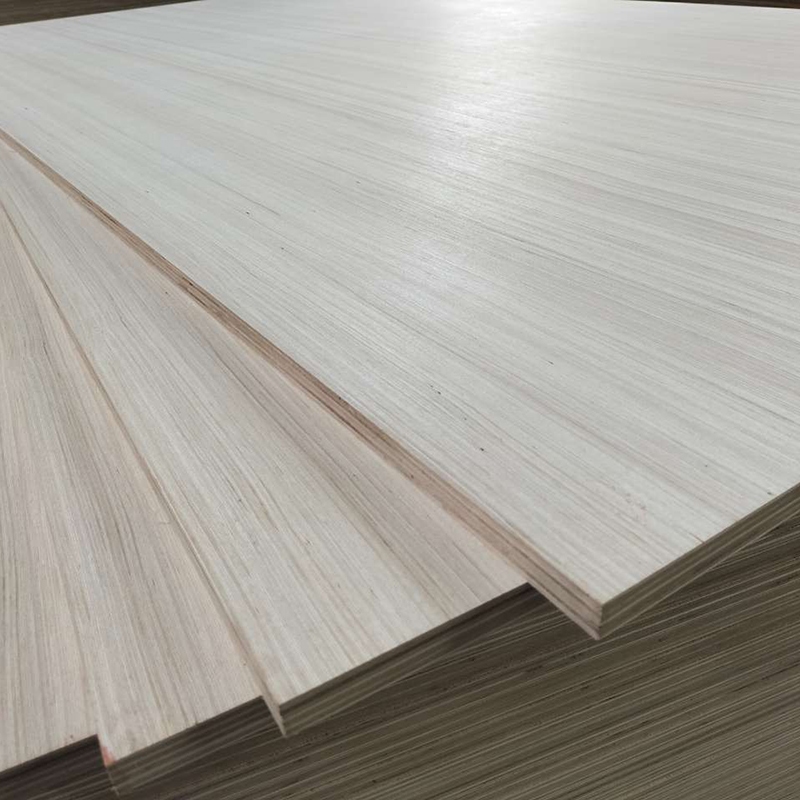
For projects where the visible wood appearance is part of the design, MDF is not the only option. Birch Plywood uses cross-laminated veneer construction rather than refined fibres, making its exposed layered edge and natural face suitable for displays intended to show a real wood character. MDF remains preferable when the specification calls for routed profiles, an opaque painted finish, smooth broad surfaces, and consistent machining without visible wood grain.
Moisture conditions create another material boundary. EN 622-5:2010 separates boards intended for dry conditions from MDF.H grades intended for humid conditions. For panels above 12 mm and up to 19 mm, the listed 24-hour thickness-swelling limit is 12% for general-purpose dry-condition MDF and 8% for general-purpose MDF.H. A better moisture grade does not turn an indoor fibreboard fixture into an outdoor product; edges, joints, coatings, and repeated water contact still matter.
Store cleaning procedures should therefore appear in the fixture specification. A display that is wiped with a damp microfiber cloth is exposed differently from a plinth repeatedly contacted by wet floor-cleaning equipment. Bases near entrances, grocery refrigeration, floral areas, cafés, or wash zones may need sealed edges, raised feet, moisture-resistant board, plastic or metal protection, or a different substrate.
Indoor air requirements are equally measurable. Under U.S. EPA TSCA Title VI, the formaldehyde emission limit is 0.11 ppm for MDF and 0.13 ppm for thin MDF, while hardwood plywood covered by the regulation has a 0.05 ppm limit. EPA defines thin MDF as material 8 mm or less. Regulated panels are subject to third-party certification unless an applicable exemption applies, and mills must follow testing, labeling, and recordkeeping requirements.
For a commercial buyer, “low formaldehyde MDF” is therefore less useful than asking for the applicable compliance documents, panel identification, production information, and test basis. EPA guidance also requires quarterly testing for regulated panel producers under specified conditions, while quality-control testing occurs more frequently. Requirements differ between markets, so a U.S. compliance statement should not automatically be treated as proof of compliance for another jurisdiction.
Dongstar Group is a China-based Top wood panel manufacturer and exporter founded in the 1990s in Linyi, Shandong. Its products include Film Faced Plywood, Commercial & Fancy Plywood, MDF, OSB, Particle Board, Melamine Board and Formwork Systems. Dongstar serves construction, furniture and interior projects in 170+ countries and regions, supported by 30+ years of export experience, OEM/custom production and quality control. Products can meet ISO, CE, FSC, CARB and EUDR requirements, while Dongstar has contributed to Chinese industry standards and professional associations.
Large retail programs also need controls beyond the board itself. A useful pre-production sample should check outside dimensions, shelf spacing, product fit, color, gloss, routed details, fasteners, lighting, graphics, cable access, stability, assembly time, packaging, and carton labeling. A rollout of 500 displays can contain several thousand individual MDF parts, so a 2 mm drilling error repeated across a common component can become an installation problem at every location.
Flat-pack engineering can reduce shipping volume when panels are designed around repeatable connectors and installation order. Component labels, hardware bags, assembly drawings, protective corner pieces, and carton sequence should be established before mass packing. A panel that leaves the factory without damage can still arrive with chipped corners if a 40 kg package is able to move inside its carton during transit.
Procurement should therefore specify measurable requirements instead of ordering “18 mm MDF retail displays” alone. A working purchase specification can include:
-
board type, nominal thickness, density range, and applicable product standard;
-
formaldehyde class or regulatory requirement, including 0.11 ppm where TSCA Title VI applies;
-
finished dimensions and acceptable tolerances;
-
paint, laminate, veneer, gloss, texture, and approved color reference;
-
sealed, painted, banded, or concealed edge requirements;
-
expected shelf span and merchandise weight;
-
hardware type, fixing locations, and assembly cycles;
-
moisture exposure and cleaning method;
-
packaging drop, abrasion, corner-protection, and labeling requirements;
-
prototype approval and inspection sampling before production.
A 2026 retail program may require the same fixture geometry in dozens of stores but different graphic panels for seasonal campaigns. Designing removable headers, interchangeable sign holders, replaceable shelves, and accessible LED components can extend the useful life of the main MDF structure. Instead of rebuilding the whole fixture after one campaign, the retailer can replace a smaller group of parts while retaining the larger panels, provided the joints and finishes were designed for repeated use.